Auxiliary Adjective (い) (Basic ㊦ 373)
An auxiliary adjective which indicates that the preceding sentence is the speaker’s conjecture based on what he has heard, read or seen.
Equivalent: Seem; look like; apparently; I heard
| (i) {V/Adjective い} informal | らしい | |
| {話す /話した} らしい | It seems that someone (will) talk/talked | |
| {高い /高かった} らしい | It seems that something is/was expensive | |
| (ii) {Adjective な stem/ Noun} | {Ø/だった} らしい | |
| {静か /静かだった} らしい | It seems that something is/was quiet | |
| {先生 /先生だった} らしい | It seemst aht someone is/was a teacher |
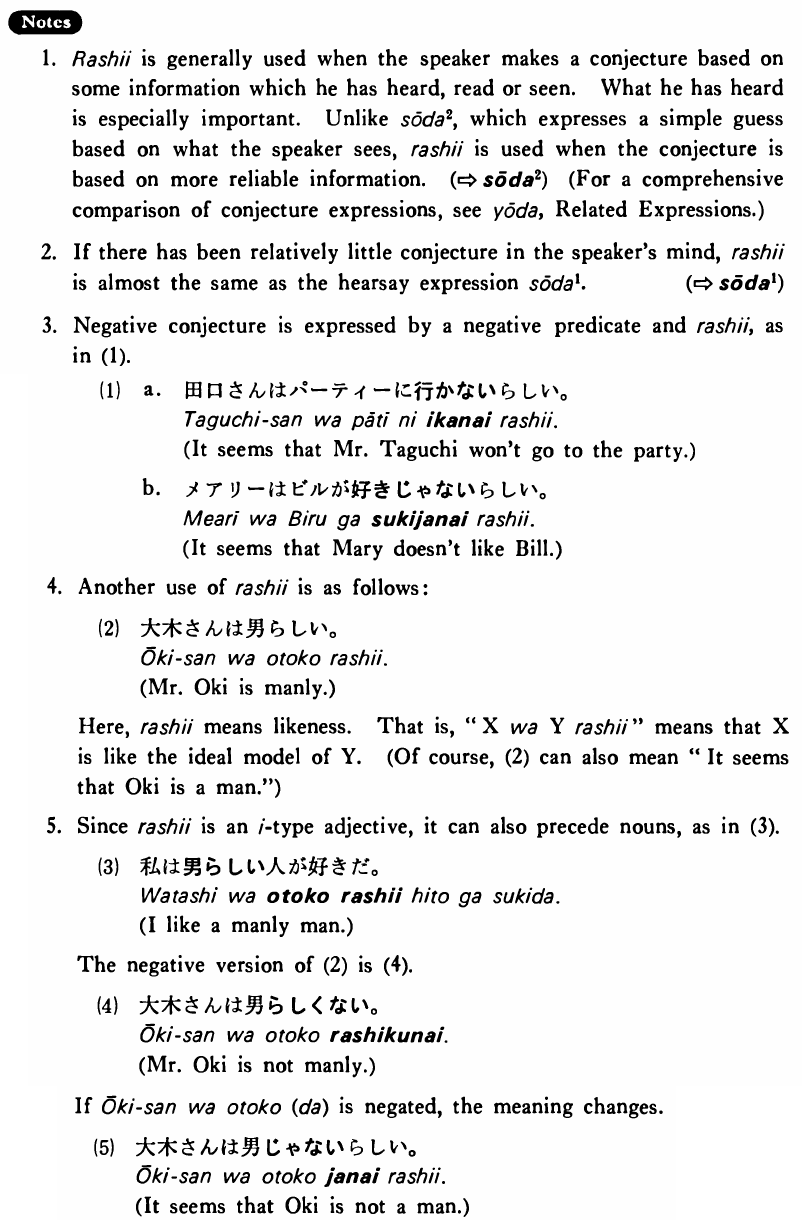
1. らしい is generally used when the speaker makes a conjecture based on some information which he has heard, read or seen. What he has heard is especially important. Unlike そうだ2, which expresses a simple guess based on what the speaker sees, らしい is used when the conjecture is based on more reliable information. (⇨ そうだ2) (For a comprehensive comparison of conjecture expressions, see (⇨ ようだ, Related Expressions.)
2. If there has been relatively little conjecture in the speaker's mind, らしい is almost the same as the hearsay expression そうだ1.
(⇨ そうだ1)
3. Negative conjecture is expressed by a negative predicate and らしい, as in (1).
4. Another use of らしい is as follows:
Here, らしい means likeness. That is, "XはYらしい" means that X is like the ideal model of Y. (Of course, (2) can also mean "It seems that Oki is a man.")
5. Since らしい is an い type adjective, it can also precede nouns, as in (3).
The negative version of (2) is (4).
If 大木さんは男(だ) is negated, the meaning changes.